
When most people think about their electric fence, they focus on the energizer—the “brains” of the system. But there is another component just as critical to long-term performance: the wire.
The wire carries the electrical pulse along your entire perimeter. It is exposed to sunlight, rain, humidity, and dust every single day. In Pakistan’s varied climate—from Karachi’s coastal salt air to Lahore’s extreme temperature cycles—not all wire holds up equally. At Durable Technologies, we use 316-grade stainless steel wire on every installation. Here is why your choice of wire matters more than you realize.
The Three Main Types of Electric Fence Wire
1. Standard Galvanised Steel Wire
This is the most common and least expensive option. It is steel wire coated in a thin layer of zinc for basic corrosion protection. In Pakistan’s monsoon humidity or coastal air, this zinc layer wears off quickly. Once rust sets in, electrical conductivity drops, the wire weakens, and it eventually snaps.
2. High-Tensile Galvanised Wire
An improvement over standard wire, this uses a stronger steel alloy that maintains tension better. While it is a reasonable choice for agricultural fencing in very dry areas, it still has limitations in urban security settings where humidity is a factor.
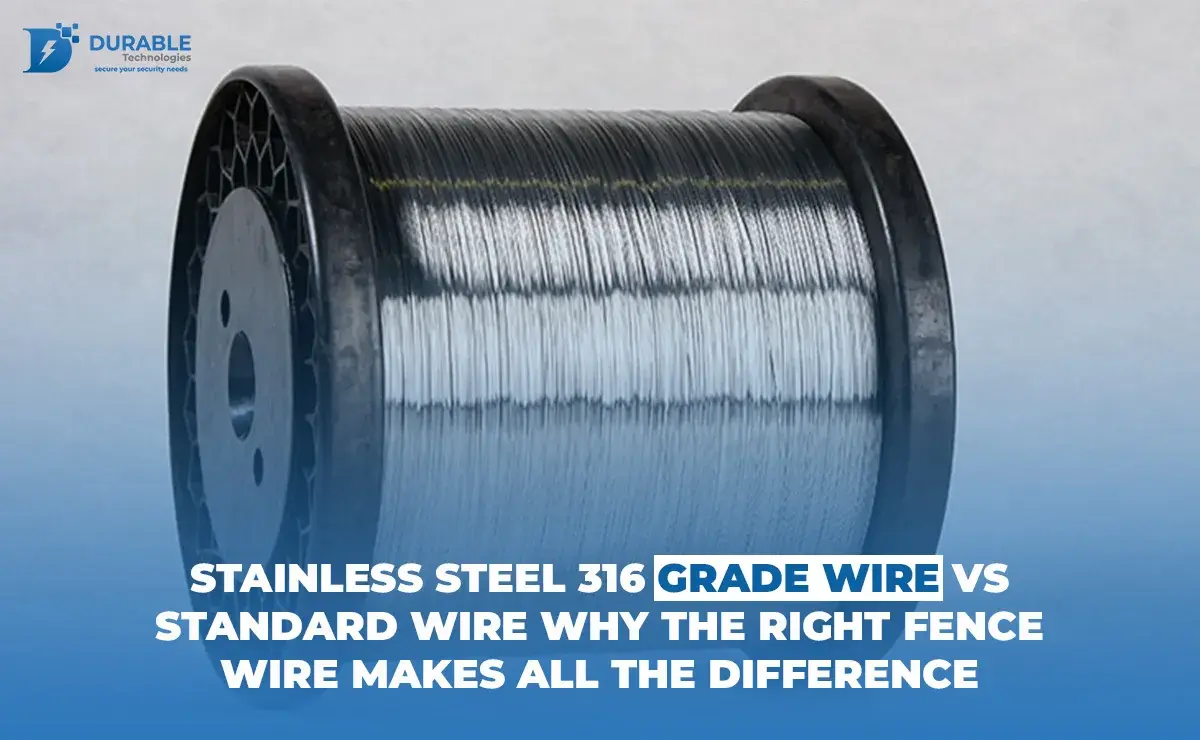
3. 316-Grade Stainless Steel Wire
This is the gold standard. Grade 316 contains molybdenum, which makes it significantly more resistant to salt and chloride corrosion. It delivers a level of durability that no galvanised wire can match in Pakistan’s conditions.
Why Rust is a Security Risk
Corrosion is not just an aesthetic issue; it directly impacts your security:
- Voltage Drop: Rust is a poor conductor. As wire corrodes, resistance increases, leading to lower voltage at the far end of your fence.
- Structural Failure: Corroded wire becomes brittle and prone to snapping. A broken strand is a wide-open gap in your security.
- Loss of Deterrence: Rusted, sagging wire looks neglected. It signals to intruders that the system might not be functional.
The “201-Grade” Trap: What to Avoid
Much of what is sold in Pakistan as “stainless steel” is actually 201-grade. It looks identical to high-quality 316-grade but lacks the molybdenum needed to resist rust. In coastal cities like Karachi, 201-grade wire can show rust spots within six months.
Durable Technologies is explicit: we use only 316-grade stainless steel. When comparing quotes, always ask for the specific grade of wire. If a supplier says “high-quality stainless” without a number, they are likely using a cheaper grade.
Pole and Bracket Quality
The wire doesn’t work alone. It sits on poles and brackets that must also resist the elements.
- Our Standard: We use hot-dip galvanised and powder-coated poles with a 110-micron coating.
- The Warranty: Because our coating quality is so high, our poles come with a lifetime warranty. Most competitors use 201-grade stainless poles or lightly galvanised steel, which begin to lean and rust within months.
Frequently Asked Questions (FAQ)
What is the difference between 304 and 316 stainless steel? Both are stainless, but 316 contains molybdenum for superior resistance to salt air and industrial pollution. For the best long-term results in Pakistan, 316 is the correct choice.
How long does 316-grade wire last? In typical Pakistani conditions, properly installed 316-grade wire can last 15 to 20 years. This is dramatically longer than galvanised or 201-grade alternatives.
Can I rewire an existing fence with better wire? Yes. In most cases, we can retain your existing poles and insulators while replacing the old, rusted wire with 316-grade stainless steel.
Why don’t more installers use 316-grade wire? Cost. 316-grade is more expensive. Many installers use cheaper materials to provide a lower initial quote. At Durable Technologies, we prioritize long-term value over the cheapest possible price.
Durable Technologies is Pakistan’s leading electric fence company and the sole authorised distributor of Nemtek products. With over 18,500 installations nationwide, we never compromise on the quality of our materials.
Contact Durable Technologies for a free site assessment today.