
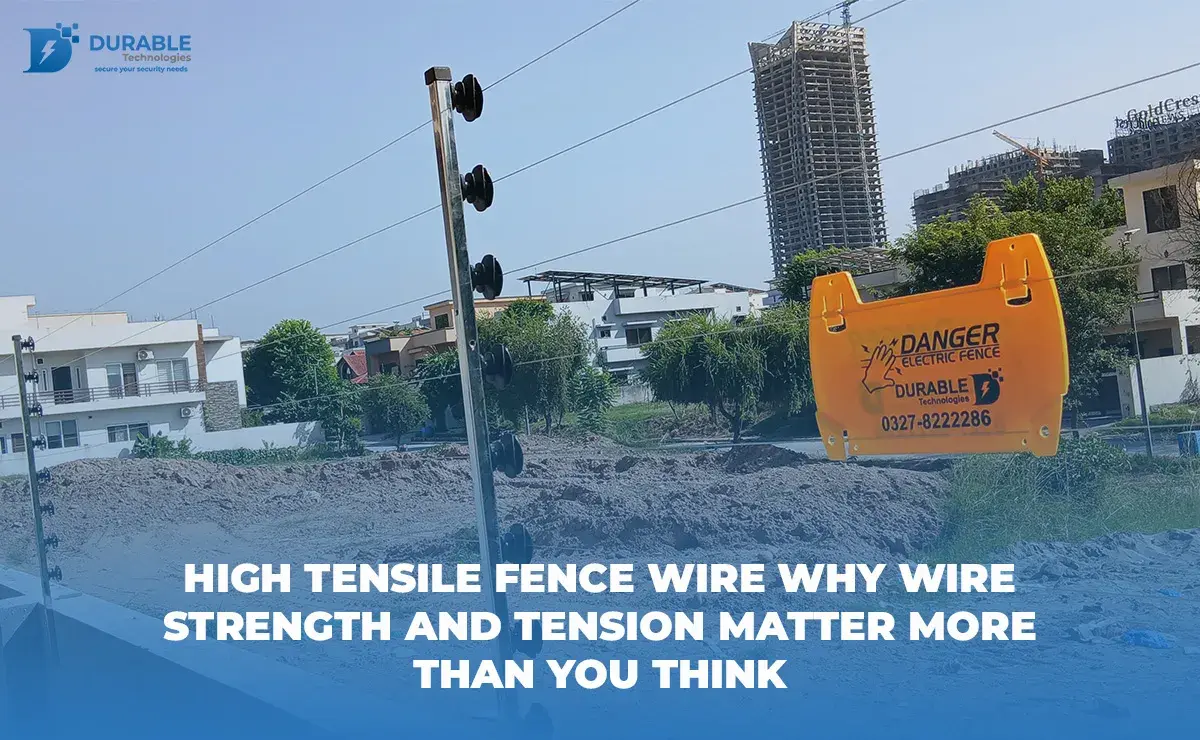
When people evaluate an electric fence, they focus on the obvious: the energizer brand or the number of wire strands. What they rarely think about is the tensile strength of the wire and whether it has been installed at the right tension.
This is a mistake. Get the tension wrong and you end up with a fence that sags, breaks, or triggers false alarms—regardless of how good the energizer is. At Durable Technologies, high-tensile wire and professional tensioning are non-negotiable on every installation.
What is Tensile Strength?
Tensile strength is the maximum stress a wire can handle before it snaps.
- Standard Soft Wire: Used in general-purpose applications, this wire stretches and sags under sustained tension, especially in Pakistan’s summer heat.
- High-Tensile Wire: Manufactured from a stronger steel alloy, it holds its tension across long spans and resists the permanent stretching that causes cheaper fences to sag.
For security fencing, high-tensile wire is the professional standard. It maintains consistent spacing between strands and resists tampering.
Why Tension is a Professional Requirement
Even the best wire fails if it is not installed correctly. Professional tensioning is a delicate balance:
- Too Loose: Sagging wire looks unprofessional and signals neglect. More importantly, it causes false alarms by touching adjacent strands during wind and can be easily pushed aside by an intruder.
- Too Tight: Over-tensioning places excessive stress on brackets and insulators. In Pakistan’s climate—where temperatures can swing 40°C between winter and summer—over-tightened wire has nowhere to go when it expands, often cracking insulators or bending poles.
- Correctly Tensioned: A properly set fence stays taut and straight through all seasons. It maintains the correct physical barrier while transmitting the electrical pulse uniformly.
The Practical Consequences of Poor Tension
When our technicians diagnose a failing fence, incorrect tension is a frequent culprit:
- Short Circuits: Sagging wires touching each other drain the energizer and trigger continuous alarms.
- Leakage: Wire touching the top of a bracket creates a leakage path, dropping the voltage across the entire perimeter.
- Broken Strands: Wires snapped at termination points are a classic sign of over-tensioning. Thermal cycling (expansion and contraction) eventually causes the metal to fatigue and break.
A Physical Barrier, Not Just an Alarm
An electric fence should be a physical barrier as well as an electrical deterrent. High-tensile wire, properly tensioned, resists being pulled apart or forced with simple tools. It holds its position under pressure.
Soft, sagging wire offers very little physical resistance. An intruder may not even need to defeat the electrical system; they can simply force the wires apart by hand and push through.
Frequently Asked Questions (FAQ)
What is the tensile strength of the wire you use? We install high-tensile 316-grade stainless steel wire. This combination provides the physical strength needed to stay taut and the chemical resistance needed to avoid rust.
How do you account for Pakistan’s temperature changes? Steel expands in summer and contracts in winter. Our technicians use specialized tensioning tools to set the wire within its “elastic range,” ensuring it remains taut in January without snapping in June.
Can my existing sagging fence be fixed? If the wire has permanently stretched, it likely needs to be replaced. However, if the sag is due to poor initial installation, our team can often re-tension the system correctly using professional equipment.
Durable Technologies is Pakistan’s leading electric fence company and the sole authorised distributor of Nemtek products. With over 18,500 installations nationwide, we ensure your fence is physically strong and electrically sound.
Contact Durable Technologies for a free site assessment today.